


How to Get Your First 100 Website Visitors as an Artist
One of the most discouraging moments for many artists is launching a website and realizing that nobody is visiting it.
Enjoying the content? Buy me a coffee to keep it coming ☕
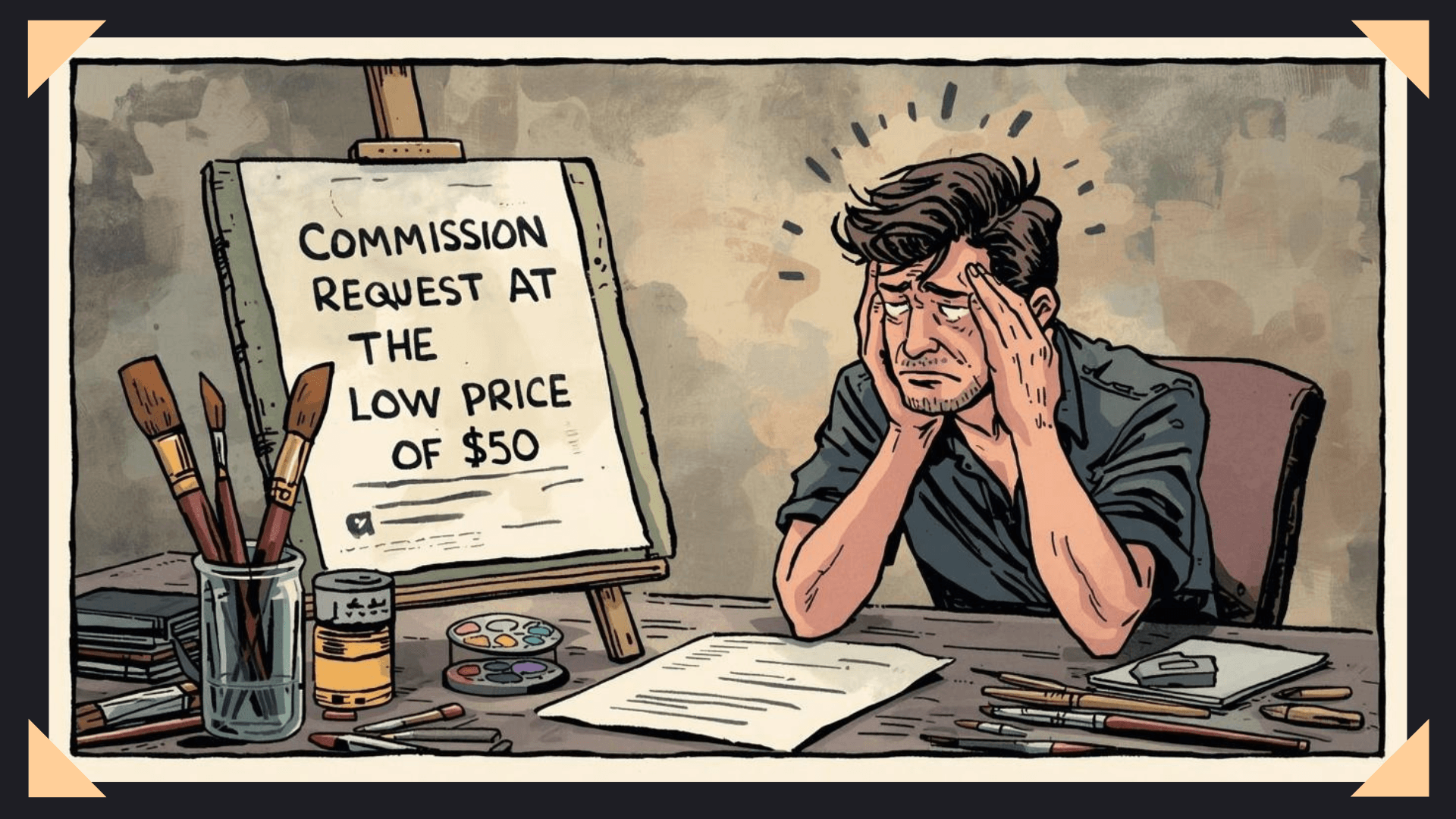
Most artists think they’re pricing their commissions logically.
They look at what other artists charge, pick a number that “feels fair,” maybe factor in time loosely—and call it a day.
But here’s the uncomfortable truth: that entire approach is backwards. And it’s the exact reason so many skilled artists end up overworked, underpaid, and quietly burned out.
Let’s break down what’s actually happening—and how to fix it.
The typical commission pricing process looks like this:
At first glance, this seems reasonable. But it’s fundamentally flawed because it starts from the outside and works inward.
You’re anchoring your value to other artists (who are often undercharging too), to client expectations (which are usually uninformed), and to time estimates that rarely reflect the full scope of the work. In other words, you’re letting the least reliable variables dictate your income.
There are three major reasons this approach fails.
First, you end up competing in a race to the bottom. When you base your prices on what others charge, you’re stepping into a marketplace where many artists undervalue their work, price emotionally, or undercut just to get more clients. Instead of discovering your true value, you’re benchmarking against instability—and that naturally pushes your pricing lower.
Second, you’re ignoring hidden labor. Most artists calculate pricing based only on drawing time, but commissions include far more than that. There’s communication, revisions, concept development, file preparation, and ongoing administrative work. What feels like a five-hour piece can easily turn into a ten- or fifteen-hour project when everything is accounted for. If you’re only charging for the visible portion, you’re effectively working at a fraction of your intended rate.
Third—and most importantly—you’re pricing based on effort instead of value. It’s common to think, “This took me eight hours, so I’ll charge for eight hours.” But clients aren’t paying for your time; they’re paying for the result, your skill level, your style, and the value the piece holds for them. A more experienced artist can complete higher-quality work in less time, and that efficiency shouldn’t reduce their income. If anything, it should increase it.
Instead of starting with the market and working inward, you need to reverse the direction. Pricing should begin with your business goals and expand outward from there. When you do that, your numbers stop feeling arbitrary and start becoming intentional.
If commissions are meant to generate real income—even part-time—you need a baseline. Decide how much you want to earn per month, then estimate how many commissions you can realistically complete without burning out.
For example, if your goal is $3,000 per month and you can handle 15 commissions, your average commission price needs to be $200. That number isn’t random—it’s a requirement. When you approach pricing this way, you stop guessing and start building a structure that actually supports your goals.
Once you have a target, you need to understand how your time is actually being spent. A commission doesn’t begin and end with drawing—it includes planning, revisions, messaging, and all the small tasks that surround the final piece.
If a single commission takes around 10 total hours and you’re charging $200, you’re effectively earning $20 per hour before taxes and expenses. For some artists, that may be acceptable. For others, it’s not sustainable. The key is awareness. When you understand your true time investment, you can adjust your pricing or workflow accordingly instead of unintentionally underpaying yourself.
This is where hesitation usually shows up. Raising prices feels risky, especially if you’re worried about losing clients. But pricing doesn’t just reflect affordability—it communicates positioning.
Higher prices tend to signal confidence, experience, and professionalism. Lower prices often suggest uncertainty or beginner-level work, even when the quality doesn’t match that assumption. Clients aren’t just buying art; they’re buying trust in the outcome. And people are generally willing to pay more when they feel confident in what they’re getting.
If your prices are too low, you may actually be attracting the wrong type of client—those who are primarily focused on cost rather than quality or long-term relationships.
Instead of quoting every commission from scratch, create a simple tiered system that gives clients clear options while keeping your process consistent.
This structure removes guesswork on both sides. It also helps anchor clients to higher-value options, making it easier for them to choose something that fits their needs without negotiating every detail.
Revisions are one of the most overlooked factors in commission pricing. When they’re unlimited, they quietly extend timelines, drain energy, and reduce your effective hourly rate.
Instead, include a fixed number of revisions—two is a common baseline—and make it clear that additional changes come with an extra fee. This doesn’t just protect your time; it also encourages clients to communicate more clearly upfront, which improves the entire process.
At the core of all of this is a simple but powerful shift:
You are not pricing to be chosen. You are pricing to be sustainable.
When you focus on being chosen, you tend to undercut, overdeliver, and attract clients who are primarily driven by price. But when you focus on sustainability, you create boundaries, attract more serious buyers, and build a system that can actually support you over time.
Not everyone will say yes—and that’s exactly how it should be.
Most artists don’t have a pricing problem. They have a framework problem.
They start from the wrong place, rely on inconsistent benchmarks, and end up stuck in a cycle that feels difficult to escape. But once you flip the direction—once you start with your goals, your time, and your value—your pricing becomes far more intentional.
Your numbers make sense. Your workload becomes manageable. And your commissions start functioning like a real business instead of a constant negotiation.
If you’ve been undercharging, it’s not because your work isn’t good enough.
It’s because you were taught to price backwards.
Want to go beyond commissions? Sign up to get the freebie and learn how to build additional income streams from your art.
One of the most discouraging moments for many artists is launching a website and realizing that nobody is visiting it.
Many artists believe they need to constantly create new artwork to make more money. The logic seems reasonable. More artwork

If you’re struggling to get commission inquiries, your artwork may not be the problem. Many artists assume that getting clients

Create beauty. Build it online—without the tech overwhelm.
Create beauty. Build it online—without the tech overwhelm.